Showing Up for Yourself and Growing: Lessons From Stanford Wrestlers

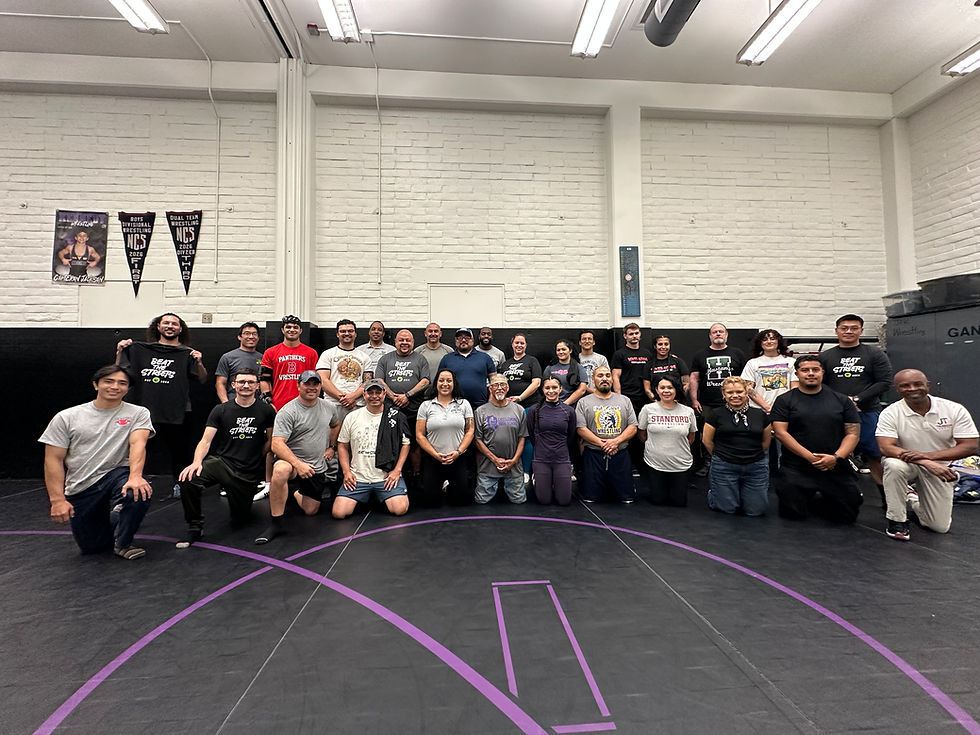
On Saturday, October 3, Beat the Streets Bay Area hosted the second clinic in its four-part From the Bay 2 The Mat series, welcoming over 30 kids to the mat. The clinic was held at Elmhurst United Middle School in Oakland.
This two-hour clinic featured three of Stanford’s elite wrestlers: Nico Provo, Grigor Cholakyan, and Tyler Knox. Provo is a two-time Division I NCAA qualifier, a former ACC and Pac-12 Wrestler of the Week, a two-time NWCA Scholar All-American, and a Pac-12 Academic Honor Roll member. Cholakyan is an NCAA qualifier, an NWCA Scholar All-American, and a member of the All-ACC Academic Team. Knox is the fourth freshman in Stanford wrestling history to earn NCAA All-American honors, a two-time NCAA qualifier, a former ACC Wrestler of the Week, and a member of the All-ACC Academic Team.
At check-in, students received free gear from Beat the Streets National, including stickers, a workout top, and shorts. Once everyone hit the mat, the clinic began with a warm-up that included dive rolls and cartwheels before moving into technique.
The Stanford athletes walked the young wrestlers through several wrestling techniques, including collar ties with elbow control to pop the arm up and set up a double-leg takedown. They also demonstrated drag-bys and a defensive head-and-arm throw that transitioned into a takedown.
Toward the end of the clinic, the young wrestlers had the opportunity to ask the Stanford athletes about their wrestling careers, what motivated them, and how they could continue improving and staying motivated.
When a young wrestler asked the Stanford athletes how they build their confidence, Cholakyan emphasized the importance of continuing to show up, even on the tough days. He explained that there will be days when your opponent gets the better of you, and other days when you come out on top. Even as Division I athletes, they still have days when they lose. But the key is to keep showing up, putting in the work, and learning from those experiences. Over time, that’s how you get better and build confidence.
Building on Cholakyan’s response, Knox added, “Yeah, I think also confidence through hard work, right? You know how hard you work in the practice room, so your confidence is going to, you know, relay out there on the mat when you’re actually competing. So just making sure you’re working hard enough to have confidence in what you’re doing.”
As the clinic came to a close, the young wrestlers and Stanford athletes came together for one final team break: “Stanford!”